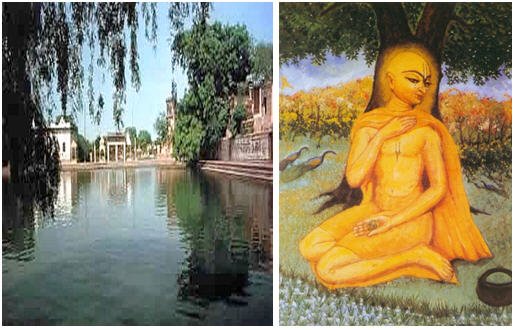
Ritudvipa (Ritudwip) – The Island of Arcana (Deity Worship)
Ritudvipa is the sixth island of Sri Navadvipa Dhama, the eternal abode of Sri Chaitanya Mahaprabhu. According to the Navadvipa Dhama Mahatmya by Srila Bhaktivinoda Thakura, each of the nine islands represents one of the nine processes of devotional service (Navadha Bhakti) described in the Śrīmad-Bhāgavatam.
Ritudvipa represents Arcanam (Deity Worship)—the loving worship of the Supreme Lord through offerings of flowers, fruits, incense, lamps, water, prayers, and devotional service.
This sacred island teaches that everything in creation exists for the pleasure of Krishna, and when all our activities are offered to Him with devotion, they become perfect.
Why is it Called Ritudvipa?
The word Ṛtu (Ritu) means "season", while Dvipa means "island."
Therefore,
Ritudvipa = "The Island of the Six Seasons."
According to the Navadvipa Dhama Mahatmya, the six seasons (Ṣaḍ-ṛtu) of India eternally reside here in their spiritual forms, joyfully serving Lord Gauranga.
These six seasons are:
- Vasanta – Spring , Grīṣma – Summer , Varṣā – Monsoon , Śarada – Autumn, Hemanta – Pre-Winter
Śiśira – Winter
Unlike the material world, where one season replaces another, in the spiritual atmosphere of Ritudvipa all six seasons simultaneously offer their unique beauty to the Lord. Everything exists solely for the pleasure of Sri Gauranga and Sri Sri Radha-Krishna. Thus, the island became famous as Ritudvipa, where all seasons eternally worship the Lord.
Spiritual Meaning of the Six Seasons
The six seasons symbolize that all conditions of life can be engaged in Krishna's service.
Whether life feels like:
- the freshness of spring,
- the heat of summer,
- the storms of the rainy season,
- the clarity of autumn,
- the calm of winter,
a devotee continues serving the Lord with unwavering devotion.
Ritudvipa therefore teaches consistency in devotional life. A sincere devotee does not worship Krishna only when circumstances are favorable. He serves in every season of life.
Ritudvipa Represents Arcana
Among the nine limbs of devotional service:
- Śravaṇam
- Kīrtanam
- Smaraṇam
- Pāda-sevanam
- Arcanam
- Vandanam
- Dāsyam
- Sakhyam
- Ātma-nivedanam
Ritudvipa corresponds to Arcanam.
Arcana means worshiping the Lord according to authorized scriptures with love and attention.
Deity worship includes:
- Offering flowers , Offering Tulasi leaves , Dressing the Deities , Cooking bhoga , Offering incense , Offering lamps (Ārati) , Chanting prayers , Decorating the altar , Cleaning the temple , Making garlands , Offering seasonal fruits and flowers
Although these activities appear external, they gradually purify the heart and awaken pure devotion.
Why is Arcana So Important?
Many devotees ask:
"If Krishna is everywhere, why worship the Deity?"
Gaudiya Vaishnava philosophy explains that the Deity is not an idol. The Deity is Krishna's Arcā-vigraha—His merciful manifestation that accepts our service. Out of compassion, the Supreme Lord agrees to appear in a form that devotees can see, decorate, worship, and lovingly serve.
Through Arcana we learn:
- cleanliness
- punctuality
- discipline
- humility
- concentration
- loving attention
These qualities gradually transform the heart.
Sri Jayadeva Goswami and the Glories of Ritudvipa
One of the most cherished traditions associated with Ritudvipa is that Sri Jayadeva Goswami, the celebrated author of the Gita Govinda, resided and performed bhajana in this sacred island. Inspired by the transcendental atmosphere of Navadvipa Dhama and absorbed in meditation on the divine love of Sri Sri Radha and Krishna, he composed portions of his immortal masterpiece, the Gita Govinda.
The Gita Govinda is one of the greatest devotional works in Sanskrit literature. It poetically describes the transcendental loving pastimes of Sri Sri Radha and Krishna and has inspired saints, devotees, musicians, and temple worship for centuries. Even today, verses from the Gita Govinda are sung in many Vaishnava temples, especially during the worship of Lord Jagannath.
The Divine Writing of "Dehi Pada Pallavam Udaram"
A famous pastime connected with Jayadeva Goswami beautifully illustrates the Lord's affection for His devotee. While composing the Gita Govinda in Ritudvipa, Jayadeva reached the verse in which Sri Krishna lovingly requests Srimati Radharani:
"Dehi Pada Pallavam Udaram"
"Please place Your soft lotus feet upon My head."
Jayadeva hesitated. He thought:
"How can the Supreme Personality of Godhead place the lotus feet of His devotee upon His own head? This is too exalted for me to write."
Unable to continue, he left for the river to bathe.
During his absence, Lord Krishna Himself appeared in the exact form of Jayadeva Goswami, entered the house, took the manuscript, and personally wrote the verse:
"Dehi Pada Pallavam Udaram."
When Jayadeva returned, he was astonished to find the verse already written. His wife, Padmavati, explained that she had seen him return home earlier, write on the manuscript, and then leave again.
Jayadeva immediately understood that Sri Krishna Himself had completed the verse, confirming that the Lord is conquered by the pure love of His devotees. Overwhelmed with ecstasy, Jayadeva offered heartfelt prayers, realizing that his work had been personally accepted by the Lord.
Connection with Ritudvipa
This beautiful pastime perfectly reflects the mood of Ritudvipa, the island of Arcana (loving worship).
Just as the six eternal seasons worship Lord Gauranga with flowers, fragrances, and beauty, Jayadeva Goswami worshipped the Lord through poetry, music, and pure devotion. His Gita Govinda is considered an offering of love rather than merely a literary composition.
Places to visit:
1. Gaura-Gadadhara Temple
The Gaura-Gadadhara Temple is one of the principal places of worship in Ritudvipa. Here, devotees have the opportunity to take darśana of Sri Chaitanya Mahaprabhu and Sri Gadadhara Pandita together.
Sri Gadadhara Pandita is revered as the embodiment of Srimati Radharani's compassionate mood and is one of the Pañca-tattva. The worship of Gaura-Gadadhara reveals the confidential mood of devotion, where Sri Gauranga accepts the loving service and worship of His eternal associates.
3. Vidyanagar – The Sacred Land of Divine Learning
One of the most important places within Ritudvipa is Vidyanagar, historically renowned as one of the greatest centers of Sanskrit learning in Bengal.
Why is it called Vidyanagar?
The name comes from two Sanskrit words:
- Vidyā – Knowledge or learning.
- Nagara – Town or city.
Thus, Vidyanagar means "The City of Divine Knowledge." For centuries, scholars from all parts of India came here to study.
Many celebrated paṇḍitas established their schools (ṭolas) here, making Vidyanagar one of the foremost centers of traditional Vedic education.
The Birthplace of Goddess Saraswati
According to the devotional tradition of Navadvipa Dhama, Vidyanagar is glorified as the appearance place of Goddess Saraswati, the eternal goddess of wisdom, learning, music, arts, and eloquence.
It is said that because the goddess of learning manifested her mercy here, Vidyanagar became filled with extraordinary spiritual and intellectual brilliance. The atmosphere naturally inspires study, contemplation, scriptural discussion, and devotion.
The Glories of Vidyanagar
1. The Center of Spiritual Learning
Vidyanagar teaches that true knowledge culminates in devotion to Krishna.
Academic excellence alone is not the ultimate goal; real education awakens humility and loving service to the Supreme Lord.
2. A Place Sanctified by Mahaprabhu
During His youth, Nimai Paṇḍita (Sri Chaitanya Mahaprabhu) displayed unparalleled scholarship in Navadvipa, defeating many renowned scholars while simultaneously teaching that devotion surpasses dry intellectual pride.
Vidyanagar reminds pilgrims that all knowledge reaches perfection when dedicated to Krishna's service.
3. The Meeting of Knowledge and Devotion
Ritudvipa represents Arcana (Deity Worship), while Vidyanagar emphasizes Vidyā (Divine Knowledge).
Together they teach that:
- Knowledge without devotion becomes pride.
- Worship without understanding may become mechanical.
- When knowledge and devotion unite, they produce pure bhakti.
Pilgrim's Reflection
As pilgrims visit the Gaura-Gadadhara Temple, Radha-kunda, Shyama-kunda, and Vidyanagar, they are reminded that every offering, every prayer, every lesson, and every act of worship should culminate in loving service to Sri Sri Radha-Krishna and Sri Sri Gaura-Nitai.
Note: The tradition identifying Vidyanagar as the birthplace of Goddess Saraswati belongs to the devotional heritage of Navadvipa Dhama and is cherished within local Gaudiya Vaishnava pilgrimage literature. It should be understood as a sacred theological tradition rather than an established historical claim.
Pilgrim's Prayer
"O sacred Ritudvipa, where the six eternal seasons lovingly worship Sri Gauranga, kindly bless me with a pure heart for Deity worship. May every flower I offer, every prayer I recite, every meal I prepare, and every action of my life become an offering at the lotus feet of Sri Sri Radha-Krishna and Sri Sri Gaura-Nitai. Please awaken within me the spirit of constant devotion in every season of my life."