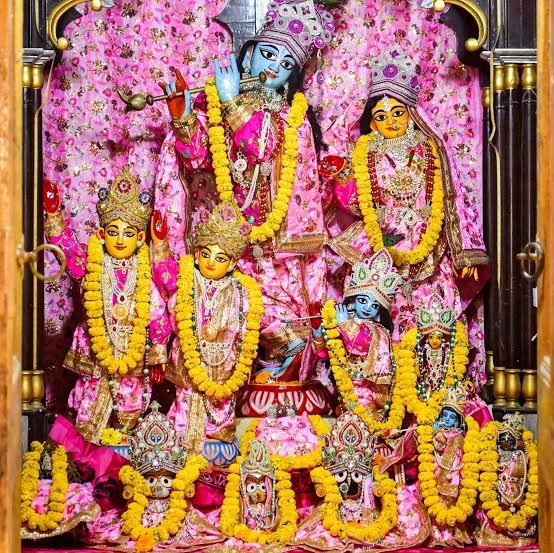
Madadrumadvipa (Madadrumadwip) – The Island of Dāsyam (Loving Service)
Madadrumadvipa is the eighth island of Sri Navadvipa Dhama and represents Dāsyam (loving service), one of the nine processes of devotional service (Navadha Bhakti).
The island is especially glorious because it is associated with the visit of Lord Rama, Sita Devi, and Lakshmana during Their exile. Here, Lord Rama became absorbed in meditation on the future appearance of Sri Chaitanya Mahaprabhu and His congregational chanting of the Holy Name.
Why is it Called Madadrumadvipa?
The name comes from three Sanskrit words:
- Mada – Joy, divine ecstasy, or spiritual bliss.
- Druma – Tree.
- Dvipa – Island.
Thus, Madadruma means "The Island of the Blissful Tree."
According to the Navadvipa Dhama Mahatmya, Lord Rama rested beneath a magnificent banyan tree during His exile. While sitting there with Sita Devi and Lakshmana, He experienced profound joy upon foreseeing the future advent of Sri Chaitanya Mahaprabhu and His Sankirtana movement. Because this sacred tree became the place where Lord Rama experienced divine bliss (mada), the island came to be known as Madadrumadvipa.
Glorification of Madadrumadvipa
1. The Island of Dāsyam
Madadrumadvipa represents Dāsyam, the devotional mood of becoming the Lord's humble servant.
Lord Rama's life is the perfect example of duty, humility, compassion, and ideal conduct. Pilgrims visiting this island pray for the strength to serve the Lord and His devotees with sincerity and without selfish motives.
2. Lord Rama Glorified Sri Chaitanya Mahaprabhu
Gaudiya Vaishnava tradition narrates that while resting in Madadrumadvipa, Lord Rama revealed to Sita Devi and Lakshmana that in the age of Kali He would appear as Sri Chaitanya Mahaprabhu to distribute Krishna-prema through the chanting of the Hare Krishna Mahamantra.
Thus, Madadrumadvipa beautifully unites the pastimes of Rama-lila and Gaura-lila.
3. The Lesson of the Banyan Tree
The banyan tree under which Lord Rama rested symbolizes shelter.
Just as the tree gave shade and protection to Lord Rama, the mercy of Sri Chaitanya Mahaprabhu gives shelter to every soul in Kali-yuga.
Pilgrims meditate here on taking complete shelter of the Holy Name.
Spiritual Lessons of Madadrumadvipa
Madadrumadvipa teaches that:
- The greatest position is to become the servant of the Lord.
- Humility is the ornament of a devotee.
- Lord Rama and Lord Gauranga are the same Supreme Lord appearing in different pastimes.
- The Holy Name is the shelter for everyone in Kali-yuga.
- Service performed with love is more valuable than service performed for recognition.
Essence of Madadrumadvipa
Madadrumadvipa is the island where service becomes joy. It teaches that the highest perfection of life is not wealth, fame, or scholarship, but becoming a humble servant of the Lord. As Lord Rama found joy beneath the sacred banyan tree by contemplating the future mercy of Sri Chaitanya Mahaprabhu, every pilgrim is invited to discover that same joy through selfless service, devotion, and the chanting of the Holy Name.
add saranga murari house and his pasttimes. and vrindavan das thakura house and his pastimes
Places to Visit in Madadrumadvipa
1. Śrī Śārṅga Murāri (Śārṅga Ṭhākura) Śrīpāṭa
One of the most sacred places in Madadrumadvipa is the residence (Śrīpāṭa) of Śārṅga Ṭhākura, also known as Śārṅga Murāri. He was one of the intimate associates of Sri Chaitanya Mahaprabhu and was renowned for his deep devotion, simplicity, and strict adherence to devotional principles.
The Wonderful Pastime of Murāri
One day, Mahaprabhu lovingly instructed Śārṅga Ṭhākura to accept a disciple. Feeling unqualified and reluctant, Śārṅga Ṭhākura prayed for the Lord's guidance and made a vow:
"Tomorrow morning, I shall initiate the very first person I see."
The next morning, after bathing in the Ganges, he noticed the body of a young boy floating on the water. Believing this to be the first "person" he had encountered that day, Śārṅga Ṭhākura faithfully kept his promise. Leaning close to the boy's ear, he chanted the Hare Krishna Mahāmantra and gave him initiation.
By the inconceivable power of the Holy Name and the mercy of Sri Chaitanya Mahaprabhu, the boy immediately came back to life.
The boy was later known as Murāri (also called Murāri Caitanya in some traditions). He became an exalted devotee and spent his life in the service of his spiritual master.
Spiritual Lesson
This pastime demonstrates:
- The unlimited power of the Holy Name.
- The potency of a pure devotee's mercy.
- The importance of faithfully carrying out the order of the Lord.
- That devotional life begins by receiving genuine spiritual shelter.
Today, pilgrims visit Śārṅga Ṭhākura's Śrīpāṭa to pray for firm faith in the Holy Name and sincere dedication to Guru and Krishna.
2. Birthplace of Śrīla Vṛndāvana Dāsa Ṭhākura
Madadrumadvipa is also intimately connected with Vṛndāvana Dāsa Ṭhākura, who is glorified as the Vyāsa of Gaura-līlā because he composed the Chaitanya Bhagavata, the earliest comprehensive biography of Sri Chaitanya Mahaprabhu.
His mother was Nārāyaṇī Devī, who as a young girl received the direct mercy of Mahaprabhu during His childhood pastimes.
Vṛndāvana Dāsa Ṭhākura later became a disciple of Nityānanda Prabhu and dedicated his life to glorifying the Lord and His devotees.
The Glories of Chaitanya Bhagavata
At this sacred place, Vṛndāvana Dāsa Ṭhākura composed the Chaitanya Bhagavata, describing:
- The childhood pastimes of Nimai.
- The Navadvipa Sankirtana movement.
- The mercy of Nityānanda Prabhu.
- The appearance and mission of Sri Chaitanya Mahaprabhu.
- The unlimited power of the Holy Name.
His writing is characterized by profound devotion and unwavering faith in Mahaprabhu's divine mission.
Because of his service, devotees honor him as:
"The Vyāsa of Sri Chaitanya Mahaprabhu's pastimes."
Pilgrim's Reflection
Madadrumadvipa beautifully combines the teachings of service, surrender, and hearing.
- Lord Rama teaches the joy of humble service.
- Śārṅga Ṭhākura demonstrates unwavering obedience to the Lord's instruction and the life-giving potency of the Holy Name.
- Vṛndāvana Dāsa Ṭhākura shows that preserving and glorifying the Lord's pastimes is one of the greatest services a devotee can perform.
Together, these sacred places inspire every pilgrim to become a faithful servant of Sri Guru, the Vaiṣṇavas, and Sri Sri Gaura-Nitai, dedicating one's life to chanting, hearing, and sharing the glories of the Lord.
Historical Note: The locations associated with Śārṅga Ṭhākura and Vṛndāvana Dāsa Ṭhākura are preserved through long-standing Gaudiya Vaishnava tradition and are revered as important pilgrimage sites within the Navadvipa Parikrama. Some historical details vary among different lineages, but their spiritual significance is universally cherished by devotees.